
SURGICAL TECHNIQUE MANUAL
SIMPLE SYSTEM
The SIMPLE System transforms a typical closed sinus lift procedure, which entails site preparation, placing graft material and then implant insertion, into a single step technique.


-
The SIMPLE system increases the mechanical performance of the bone environment by itself in a single step technique.
-
In trans-alveolar SinusLift procedure, The SIMPLE system autografting the sinus cavity by channeling residual bone into the sinus cavity.
-
The SIMPLE system by its edgeless apical portion can widening a narrow ridge
-
The SIMPLE system by its edgeless apical portion is safer with an adjacent mandibular nerve
SIMPLE system specifically designed for soft and moderate bone environments increases their stability and viability.
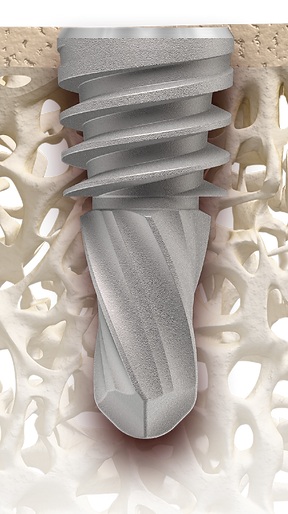
The SIMPLE implant is made of two regions, an apical section that functions as an Osteotome, and a coronal section that resemble of a standard implant, functioning as for Fixation The apical region characterized by a channeling and edgeless feature.
In challenging bone environment, instead of removing part of the precious bone out during drilling sequence, the SIMPLE system by minimal bed preparation manipulates the bone for a safer and better predictability

SOFT BONE
The more quality bone present at the implant site, the better the chances for dental implant success. Implants also stimulate the bone, preserving its volume. The best bone for dental implants is Type 2 as it provides the best osseointegration of implants. This bone also provides stability through cortical anchorage and has high vascularity. The implant can integrate fully into the bone and be functional immediately. However, in the case of soft bone (Type 4), which is less dense, it is most difficult to integrate a dental implant into and achieve short and long-term stability. Moreover, it has the longest healing time period. SIMPLE implants are designed for use especially in soft bone conditions, so that high primary stability can be achieved even in area of poor bone quality.
In cases of very low-density bone (soft bone), under-drilling techniques are recommended, to allow compression of the bone by the inserted implant. The mild compression condenses cancellous bone around the implant, increases bone-to-implant contact (BIC) levels, and of course, increases primary stability and overall bone healing.

SINGLE STEP.
The SIMPLE System transforms a typical closed sinus lift procedure, which entails site preparation, placing graft material and then implant insertion, into a single step technique.
The SIMPLE implant consists of two regions, an apical section that functions as an Osteotome and a coronal section, resembling that of a classic implant, enabling Primary Fixation.
The apical region is characterized by spiral flutes, winding in an opposite direction to the thread direction. This unique geometry enables collection of bone whilst driving it apically. Thus during Implant insertion the apical region simultaneously combines site preparation while channeling residual bone into the sinus cavity.
The apex of the implant has blunt edgeless geometry ensuring that during the elevation procedure there is no direct contact with the Schneiderian membrane. The sinus floor is raised while protecting the the membrane. Once the floor of the sinus cavity has been penetrated, the bone which has been collected by the flow by the flutes at the implant’s apex will follow the floor ( which acts as a barrier, so protecting the membrane), thus achieving the needed height for adequate implant length.
Simultaneously the coronal portion of the implant fixates the implant and no further surgical steps are needed.

As with standard implants, the placement of the SIMPLE implant requires the use of a 1.5 - 2mm diameter Pilot drill to create an initial osteotomy at the required location and angulation of the future implant.
Then, the Osteotome Portion of the SIMPLE SYSTEM paves the way to the Fixation Portion along the path created by the pilot drill, condensing the soft bone as it inserted to position.

EDGELESS SHAPE.
The osteotome portion of the implant does not cut bone. Its edgeless design ensures bone condensation during implant placement. This unique geometry of flutes winding direction and curvature surface, enable to condense the surrounding bone in a non cutting process and collection of bone whilst driving it apically.


INTERNAL CONNECTION.
The osteotome area of the implant does not cut bone. Its edgeless design ensures bone condensation During implant placement, the curvature surface and combination of concave and convex geometries mildly condenses surrounding bone laterally to ensure it remains intact.
DIMENSIONS
The SIMPLE SYSTEM is defined by its
Total length,
Outer diameter and
Fixation portion length.
In a short bone height, the fixation portion length should be in accordance.

Animation
